
Izu Islands
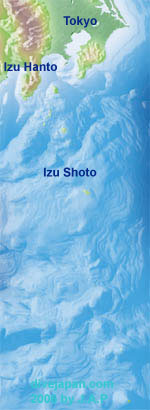
Few diving regions sit so close to a megacity yet feel so wonderfully remote. The Izu Islands (Izu-Shoto) are a chain of volcanic islands and sea-stacks scattered down the Pacific south of Tokyo, all of them part of the Tokyo Metropolitan government. Board a night ferry from Takeshiba Pier and you wake up the next morning to black volcanic shorelines, clear blue water and the steady hum of a working ocean current that pulls big fish right up to the rocks.
This is the big picture. For a closer look at the inhabited islands and what each one offers underwater, see our guide to the seven main islands, and use the maps to place them in the chain.
What makes the Izu Islands special
The whole region is shaped by one thing: the Kuroshio Current. One of the largest, warmest ocean currents on the planet, it sweeps up from the tropics and brushes the southeast coast of Japan, carrying warm, clear water and a steady supply of plankton and pelagic life past these islands. When the Kuroshio swings in close, transparency can climb past 30 meters and the deep cobalt water earns nicknames like the famous "Hachijo Blue." When it drifts south, the water cools and clarity drops, so conditions on any given week depend heavily on where the current is sitting.
That warm flow gives the islands a marine community unlike anywhere near Tokyo. You find temperate species from the Izu Peninsula mixing with tropical reef fish more typical of Okinawa. Hachijojima alone is home to several hundred fish species, including local endemics, alongside coral, nudibranchs and frogfish for those who like to look small.
Big fish and the famous hammerheads
The Izu Islands are best known for scale. Schools of amberjack, yellowtail, rainbow runners and skipjack tuna stream through the current lines, and dogtooth tuna patrol the deeper rock. The headline act, though, is the scalloped hammerhead: as the water warms, hammerheads move up the chain and gather around islands like Oshima, with thresher sharks turning up too. Sightings build through summer and tend to peak when the surface warms past about 20°C, roughly July to September. They are never guaranteed, but a calm, current-fed dive on the right day can put a shimmering wall of hammerheads overhead.
Conditions here ride on the current. Build a buffer day or two into any trip, because the best shore sites can be closed by swell and re-open the moment the Kuroshio swings back in.
Dolphins at Mikurajima
For many travelers the real magic is at Mikurajima, a small, steep-sided island ringed by a resident pod of wild Indo-Pacific bottlenose dolphins. The animals live here year-round and are so well studied that the local research team knows most of them by name. Because the whole island is protected parkland, you swim with them by snorkel and freedive only, always with a licensed Tokyo nature guide, never on scuba. The dolphin season runs roughly mid-April to October. Mikurajima's harbor is exposed, so landings are weather-dependent and trips can be called off at short notice.
Easy to reach, easy to underestimate
Despite the wild feel, access is straightforward. Overnight ferries leave Tokyo's Takeshiba Pier most nights and call at the islands in turn, while ANA flies from Haneda to Hachijojima in under an hour. Short helicopter hops link Hachijojima, Miyakejima and Mikurajima for travelers chasing a tight schedule. The catch is the sea: ferries and small-island landings are at the mercy of swell and the Kuroshio, so flexible dates matter more here than almost anywhere else in Japan.
Plan your dive
- Best season: Late spring through autumn. Diving is best from around June to October; hammerhead odds peak July–September, and dolphin swimming at Mikurajima runs roughly mid-April to October.
- Water temperature: Cool in winter and spring, warming through summer to the high 20s°C, occasionally near 30°C when the Kuroshio is in close.
- Visibility: Highly variable with the current; often excellent at 20–30 m or more when the Kuroshio hits the islands, lower when it drifts south.
- Level: Something for everyone, but signature sites like Hachijojima's Nazumado can carry strong current and surge and suit confident, current-comfortable divers.
- Getting there: Overnight ferry from Tokyo (Takeshiba Pier), direct ANA flight from Haneda to Hachijojima, or inter-island helicopter. Allow buffer days for weather.
Ready to choose an island? Start with the seven main islands, then check the maps to plan your route down the chain.