
 Hokkaido
Dive Okinawa, dive a different world
by Charles WhippleUntil 1879, Okinawa was a separate kingdom, a vassal nation that paid tribute both to China and to Japan. Today, Okinawa is part of Japan, but it offers a different world to sport divers.
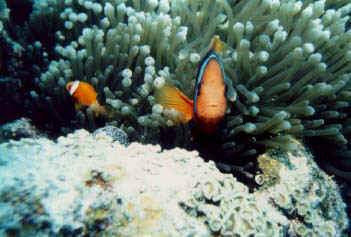
A dusky anemonefish peers from his nest at intruders. Juvenile at the left.
When it came time for the coral to spawn, at the full of the moon in June, I hied myself to Naha, Okinawa, with a bunch of scuba divers. In Tokyo, a typhoon battered the city. In Okinawa, the sun burned down out of cobalt skies; the ocean was a mirror.
Sea-la-Cans, the diving outfit docks its 39-foot 300-horsepower Yamaha boat at Naha Marina. Can Igarashi and his wife Akiko run a tight operation. But both are natives of Chiba, just outside Tokyo.
Day one we dived the labyrinth and coral gardens at Chiibishi. This group of four tiny islands lies in a direct line between the Kerama group.
Beneath the waves, coral gardens greeted us. They'd come back strongly since their 1972 decimation by Crown of Thorns starfish. Vast plots of staghorn coral, interspersed with gorgonian fans, table coral, and other species I didn't recognize. Once in a while, the blue-purple lips of a giant clam interrupted the coral continuum.
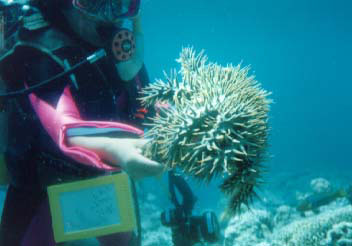
Manatees leader Yukiko Yamazaki holds a Crown of Thorns starfish on her diving knife.
Fish were bright and plentiful -- wrasses, blennies, occasional lionfish, damsels, yellow juvenile tangs, surgeons, snappers, grunts, and yuzen angels -- flashing brilliant blues and yellows, or cleverly hiding when air-breathing monsters from an alien place ventured near.
Labyrinths through the coral gave us an adventuresome dive that finished too soon, as all interesting dives, too. We tied up at WWII-vintage concrete pier on deserted Kamiyama Island for lunch, slipping in alongside another dive boat.
While our shiny fiberglass dive boats were tied up for lunch, a lone man in a floppy straw hat sat in his wooden sabani boat about 500 meters off shore, fishing with a hand line. His was the only native Okinawan craft I saw that day.
Day two was the same -- same brazen sky, same hot sun, same
mirror of an ocean.
We roared out of Naha harbor in Can's dive boat, speeding for the Kerama
islands. Chiibishi, Kamiyama Island, and that long Okinawan fisherman
disappeared astern as we steered a course north of the Keramas. Hate (say Hah-teh)
Island passed on the left, then Koku Island. Kan veered west-southwest. In the
distance, we could see the mountains of Zamami Island.
When Can slowed the boat, we were a couple of miles off the Zamami shoreline, facing a pinnacle that rose 70 meters out of the water. To ancient Okinawans, it appeared phallic, so they named it "Ugan" or Man-Rock. But considering the underwater layout, Ugan is more like an upthrusting thumb, protruding from a clenched fist of solid rock that lies 18 meters beneath the surface. The fist rests on a plateau 50 meters down. Naturally, we didn't investigate.
Basically, Ugan is a drift dive. Once we had our equipment on, Can edged the boat to within 10 meters or so of the pinnacle. We backrolled into one of the most amazing underwater vistas I have ever seen. The thumb is a huge monolith that drops sharply down to the fist. It is ridged and furrowed, but seems to be in one piece. Ugan is not a coral formation, and the sea bottom doesn't offer divers the garden of the gods views of shallower coral fields. But it's dynamic shape is breathtaking, and it gives you glimpses of sealife you don't find in the coral gardens.
For example, we happened across a small blue ribbon eel with nostrils that end in fluted yellow feathers, nestled in a cleft at the base of Ugan's thumb. Can says sharks sometimes coast the waters around the rock, but we didn't see any.
Can plucked us from the water after we surfaced, and headed for the second dive site. The second and third dives were at Ariga-kita and Bishipu-jima. Again we lunched at a deserted beach. Deserted, that is, except for mainland Japanners in shiny fiberglass boats; four including ours. Not a native Okinawan in sight.
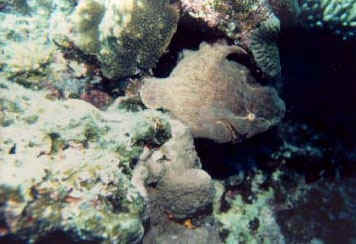
This 8-inch giant frogfish is doing his best to look like a piece of dead coral.
Ariga-kita's a rather shallow dive where we wended our way among coral heads dotting a bottom of pure white sand. After about 30 minutes of pyramid angels, lionfish, saury-pike (small barracudas), and moorish idols, we held an impromptu underwater Olympic-style long-jump competition. We shed our fins and ran slow-motion over the sand to launch ourselves toward fame and fortune. The longest "jump" was only about 10 meters, though, and swimming was not allowed. Chuckling into our regulators, we donned our fins and started back toward the boat, examining coral heads as we went.
Still, I almost swam right by him. And he was in plain sight, too. But so cleverly camouflaged that you'd think he was another chunk of coral. He knew staying motionless was his best move, so I got right in close for a good photo of my first frogfish.

One of the tassled scorpion species hugs the coral in the Kerama Islands.
The Bishipu dive rendered something unusual, too, a big scorpionfish that thought he looked exactly like a piece of coral. Stirring him a bit with a diving knife angered him, turning his fins red. That delineated him from the background, and I got a great photo.
Day three was for lazing, with the flight back to Tokyo late in the evening. I wandered down to the harbor, walking a hour or so in the hot Okinawan sun. It felt great, but I was the only one on the streets.
A small fishing harbor stands back-to-back with the Naha Marina. There I saw
my first Okinawan sabani boats close up. Almost identical in form and size to
the dories that fished the New England Grand Banks off North America a century
ago.
Twenty or so sabani sat on the concrete apron above the launching ramp. Some
were carefully tended. Others were cracked and unseaworthy.
An old man pulled
a net from a locker and threw it into his boat. "Excuse
me," I said. "What do they call these boats?" "Sabani," he
mumbled, glaring at me. He squatted in the shade of the boat with his back to
me.
I wandered off, snapping photos of the sabani on the apron. I was running my
hands over the worn planking of one boat when another old man walked by. "Are
these boats made around here?" I asked.
"Nah. No one makes them anymore," he said. "But they're the best there is. No
like those plastic jobs. Sabani cut right through the waves; don't bob around.
Nothin' like a sabani boat," he said. "Gonna get me one some of these
days."
"What do you use now?"
"That crazy plastic job," he pointed to a small 24-ft powerboat. "People don't
like to sell their sabani," he said.
The man rubbed the seam of the sabani's planking. "Needs some shark grease. Best
thing to stop the leaks. Keeps the wood from drying out, too." He looked
longingly at the boat, then turned to his plastic craft. "Got to get a sabani," he
repeated.
I climbed atop the breakwater and looked out over Naha's harbor. Major construction work was lining it with tetrapods and huge concrete walls. Okinawa was fast turning into another Japan. A sabani boat thump-thumped toward the breakwater on its one-lung engine, but it didn't seem to fit any more. It harkened back to when Okinawa was the Ryukyu Kingdom, a seafaring nation plump with trade from China, Japan, Korea, and the islands of the southern seas. It spoke of an ocean-going people now being displaced by swarms of northerners in plastic boats. I shivered under the hot Okinawan sun. Suddenly Naha harbor seemed a very lonely place.
Charles Whipple is a writer who has lived in Japan for more than 20 years. He is an avid diver and often contributes diving articles to Australian, New Zealander, Japanese, and American diving magazines. He's fluent in Japanese and willing to help any diver get acquainted in Japan.
***12/24/2023 update: Mr. Charles T. Whipple passed away in 2019. Rest in peace.
Copyright of the article and photos on this page were reserved for Charles Whipple. The copyright now belongs to the person who has inherited it.
***Posted May 31, 1998
More than a decade ago, during new year holidays, I dived Kerama Islands. We
flew in a tiny airport island of Kerama Islands by a tiny plane from Naha. It's
place of my first night dive, I still remember the dive vividly.
- Junko Pascoe
